
Oak Park City Directory Collections
An Oak Park city directory opens a window on households, street addresses, and phone listings. Each volume captures a single historical year. Old volumes help you trace a past resident across the decades. They can even help you find who lives on a street in Oak Park. Start with the surname or address you already have. Then match the spelling and the place label exactly as the volume prints it. Every entry deserves a citation with its publication year and page number. Keep in mind that a directory entry is a historical observation. It is not proof of where anyone lives today. For family, estate, or local-history questions, pair it with another dated record before drawing firm conclusions.
| Collection lead | Years or period | Where held | Access route |
|---|---|---|---|
| Michigan city directories | Oak Park leads for 1930, 1933, and 1936 | Library of Michigan | Verify the scan or catalog record |
| Royal Oak and Ferndale area directories | 1930-33, 1945-50, and 1953, with stated gaps | South Oakland County collection leads | Check the relevant volume |
| Bresser Cross-Index Directories | 1952-57 and 1964-2009 | Royal Oak Public Library guide | Confirm Oak Park inclusion by year |
| Oakland County directory sample | 1965 sample | Ferndale Historical Society | Online historical example |
Note: A collection lead tells you where to look, not that a given name or address appears in every listed year.
Oak Park's South Oakland Directory Shelf
The Library of Michigan guide places its print city directories on second-floor south shelves. They are arranged by city or county. Microfilm and fiche live in the microfilm room. They are shelved by call number. For online access, the same guide points to Ancestry Library Edition and HeritageQuest. The ANSWER catalog helps you locate a collection before making the trip. Record the call number and publication date with any transcription you make.
Polk-style books support surname searches, street searches, and phone searches alike. Street sections run alphabetically by street, then by house number. That layout shines when you know a historical address but not the exact name spelling. Even so, a directory listing is dated evidence. Compare it against a census, deed, or other source. Don't stretch it into a claim about a later period.
The Library of Michigan's city-directory overview describes the shelf locations and access paths.
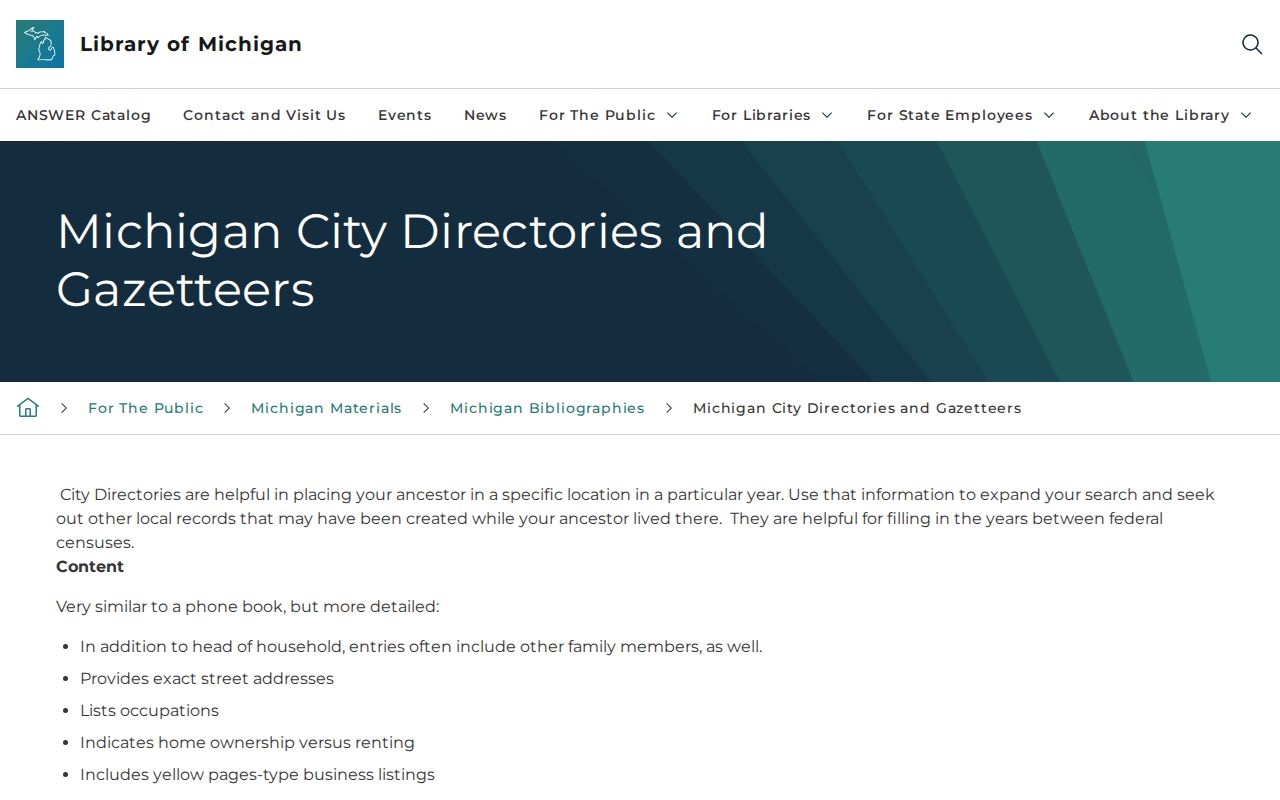
The image helps with access decisions only. Confirm the specific year before relying on any directory citation.
Oak Park Directory Years Need Checking
Oak Park-specific genealogy leads point to 1930, 1933, and 1936 U.S. City Directories on Ancestry. Treat them as starting points. Individual issues and addresses still need checking. Gale's directory-history material also flags Royal Oak and Ferndale area runs that may include Oak Park. It reports 1930-33 with 1931 and 1932 missing, 1945-48 with 1946 and 1947 missing, 1948-50 with 1949 missing, and a 1953 run.
Gaps should redirect a search, not end it. Try an adjacent year. Try a library shelf, a newspaper, a census, a deed, or an archival source. The Royal Oak Public Library local-history guide separately lists Bresser Cross-Index Directories for South Oakland County covering 1952-57 and 1964-2009. Its description does not promise Oak Park inclusion. Ask about the target year and community first.
| 1930-33 | Area-directory lead, with 1931 and 1932 identified as missing. |
|---|---|
| 1945-48 | Area-directory lead, with 1946 and 1947 identified as missing. |
| 1948-50 | Area-directory lead, with 1949 identified as missing. |
| 1952-57 and 1964-2009 | Bresser Cross-Index runs listed by the Royal Oak guide, subject to shelf confirmation. |
Reading an Oak Park City Directory Entry
A 1965 Oakland County directory sample lays out a typical entry: name, city or township label, street address, and phone. Oak Park examples appear in the sample. However, historical names and addresses are not reproduced here. Read each entry as a year-stamped lead, nothing more. The Library of Michigan guide notes that other runs can add household, address, classification, business, or phone details. Fields differ from one publisher and edition to the next.
| Listed name | The name printed for that directory year, including its exact spelling. |
|---|---|
| City or township | The jurisdiction label used by the volume, which may differ across years. |
| Street address | The historical street location attached to that entry. |
| Phone | A phone field when the particular directory prints one. |
- City directory
- A dated published listing used to locate a person, address, street, or phone reference in a particular year.
- Criss-cross section
- An address-oriented arrangement that can place listings by street and house number when the directory includes one.
- Householder index
- A name arrangement used to find a listed household when a volume supplies that index.
- Abbreviation key
- A legend printed in some volumes. Read it before interpreting shortened labels or symbols.
Oak Park's 1945 Directory Boundary
Oak Park's official history traces the postwar city to portions of Royal Oak Township. The city status election and the charter both date to 1945. That year creates a useful research boundary. A pre-1945 entry may be filed under Royal Oak Township or another nearby label even when the place now belongs to Oak Park. Post-charter sources can carry the Oak Park city label instead. Always preserve the wording printed in the source rather than quietly swapping in the modern name.
This is a records-geography problem as much as a naming one. A 1930s directory, voter book, census page, plat, or deed should be cited under its original jurisdiction. The Archives of Michigan Oakland County guide lists Royal Oak Township voter books for 1928-32, plus older county materials that can help test a historical label.
Oak Park Library and Archives Fallback
For directory questions that start local, the Oak Park Library sits at 14200 Oak Park Blvd. Its published contacts are 248-691-7480 and reference@oakparkmi.gov. Hours run Monday through Thursday from 10 to 8. Friday hours are 10 to 5, Saturday is closed, and Sunday runs 1 to 5. The library's own page does not name a city-directory, obituary, or local-history collection. That silence means holdings can vary. A specific surname, year, address, or collection title is the right question for the reference desk. The library is a starting point. It is not proof that a particular directory volume is on the shelf.
When the local route comes up empty, widen the net. The Library of Michigan catalog comes first, then the Archives of Michigan. The archives notes that not all holdings are digitized or name-indexed. So a catalog search is only the opening move. Its visit guidance covers photo-ID requirements, public computers, Ancestry access, open stacks, and reading-room hours. Two more catalog-based leads exist. One is the Oakland County Pioneer and Historical Society. The other is the Oakland County Genealogical Society.
Tracing an Oak Park Household by Year
Family history, estate work, and old-address questions all benefit from a simple date sequence. Test one historical connection at a time. The aim is not a profile built from loosely matched names. The National Archives census collection reaches through 1950, which pairs naturally with directory years. Match the city or township label, enumeration district, page, and line against the city directory year. Neither source is a current record, so treat both as historical snapshots.
- Choose a surname or address and a target directory year.
- Copy the entry exactly, including the jurisdiction label and street spelling.
- Check the nearest available directory year, while marking any stated collection gap.
- Compare the result with the appropriate census year or another dated county record.
- For a property question, continue through the previous-residents research route with the address, source year, and parcel details kept separate.
A household can vanish from a directory for many reasons. A move, a missed listing, a name change, a publication gap, or a jurisdiction change can all produce the same blank line. The directory alone cannot tell you which explanation fits. Only independent evidence settles it. A disappearance is a lead, never a conclusion.
Note: Cite the publication year and page even when the entry looks obvious, so later researchers can separate a printed observation from a later record.
Oak Park Directory Citations Stay Dated
A useful Oak Park city directory note has four parts. List the title or publisher. Add the year, the page or image, and the exact city or township wording. For a digital copy, add the date you accessed the source. That small record keeps a 1936 listing distinct from a 1950 census observation or a later parcel display. It also exposes a spelling difference instead of forcing a match.
When a name appears in several kinds of historical records, compare the date first. Directory, census, deed, tax, and probate sources each answer a different question. A careful citation trail protects family-history work from overstatement. It also leaves a clear route back to the custodial source.
The exact volume will sometimes stay out of reach. Write down the years checked and the catalog or shelf route used. A missing entry can reflect a collection gap. It can also reflect a variant spelling, an omitted listing, or a different jurisdiction label. That note keeps the question open for a later library or archival visit. An incomplete search is not a conclusion; it is a record of where to resume.